
guide3/24/20268 minRanketic Team
The Flesch Index: History, Formula and Relevance
The Flesch Index has been the standard measure of readability for over 75 years.
The Flesch Index has been the standard measure of readability for over 75 years.
Anyone who writes wants to be read. But how do you measure if a text is easy to read? The Flesch Index has given a clear answer since 1948. It measures readability on a scale from 0 to 100. A high score means easy text, a low score means hard text. In this article, we cover the history behind the formula, its variants, and why it matters for SEO and GEO today.
Rudolf Franz Flesch was born in Vienna in 1911. He studied law and earned his degree in Austria. After the Anschluss in 1938, he fled to the United States. There he started a new life. At Columbia University in New York, he wrote his doctoral thesis. His topic: How can you write texts that everyone can understand?
In 1943, he presented his first formula. Five years later, in 1948, the well-known version appeared. He called it "A New Readability Yardstick" in the Journal of Applied Psychology. The core idea was simple: short sentences and short words make texts easier to read.
"Write the way you talk." – Rudolf Flesch, 1946
Flesch became one of the most famous advocates of plain language in the United States. His book "Why Johnny Can't Read" (1955) sparked a broad debate about the education system. He died in 1986 in Dobbs Ferry, New York. His legacy lives on in the formula that bears his name.

The formula uses two factors: the average sentence length (Satzl\u00e4nge) (ASL) and the average number of syllables per word (ASW). Both values are easy to derive from any text.
The Flesch Reading Ease formula for English texts is:
FRE = 206.835 − 1.015 × ASL − 84.6 × ASW
The result falls on a scale from 0 to 100. The higher the score, the easier the text. Long sentences and long words lower the score. Short sentences and short words raise it. The formula is simple but effective: it explains about 70 percent of the variance in reading tests.
The English formula does not work well for German texts. German words are longer on average than English ones. This is due to compound words: "Versicherungsbedingungen" (insurance terms), "Datenschutzverordnung" (data protection regulation), or "Magnetresonanztomographie" (MRI) all have many syllables. A German text with the same content as an English one will always have a lower Flesch score.
Toni Amstad solved this problem in 1978. He adapted the formula for the German language. His version is known as the Amstad Formula or Flesch Index (German):
FRE (DE) = 180 − ASL − 58.5 × ASW
The base value of 180 is lower than the English 206.835. The weight for syllable count is also adjusted at 58.5. This way, the formula produces meaningful scores for German texts on the same 0-to-100 scale.
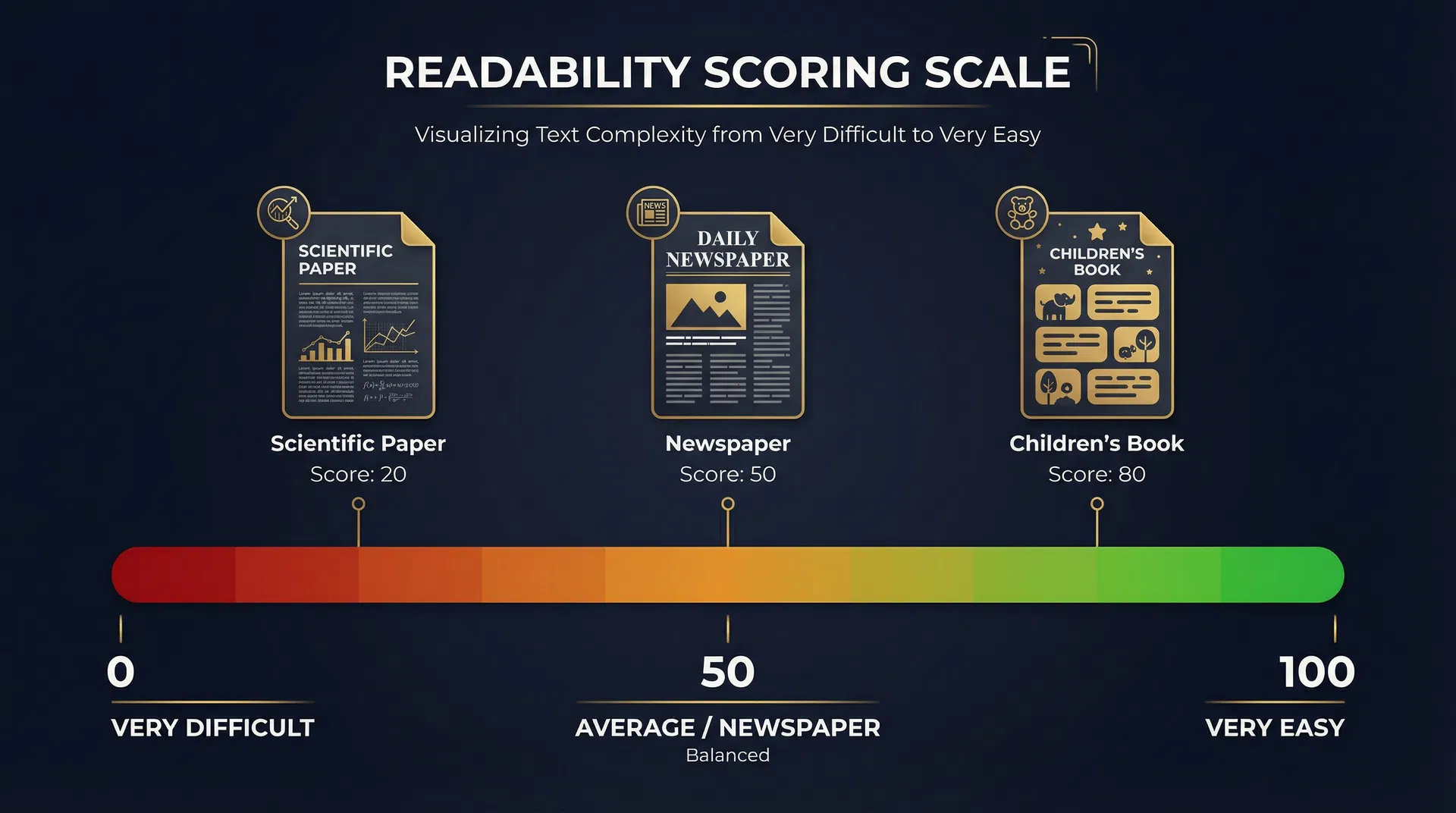
The scale divides texts into levels. Here is the common breakdown:
For web content and blog articles, a score of 50 to 69 is ideal. In this range, texts are detailed enough but still accessible. For SEO tools like Ranketic, this range serves as the benchmark for the Ranketic Score.
Google has stated many times that the Flesch Index is not a direct ranking factor. A study by Ahrefs (2021) with 15,000 keywords found no link between Flesch scores and Google rankings. Does that mean readability does not matter? No.
Readability has an indirect effect on rankings. Easy-to-read texts lead to:
All of these signals feed into the user experience, which Google does evaluate. Yoast SEO, one of the most popular WordPress plugins, uses the Flesch Index as a core part of its content analysis. This shows that the SEO industry takes readability seriously.
A study by Upward Engine (2026) also found that content scoring 60 to 70 on the Flesch scale generates about 30 percent more leads than hard-to-read texts. The reason: readers stay longer, understand better, and take action more often.
GEO stands for Generative Engine Optimization. It is about how well AI systems like ChatGPT, Perplexity, or Google AI Overviews can understand and cite your content.
AI models work with language patterns. They prefer texts that are clearly structured. Short sentences, simple words, and a logical layout help the AI grasp the content correctly. A text with a Flesch score of 55 is processed better by an AI than one with 25.
The Princeton study on GEO (2023) shows that content with clear structure, quotes, and statistics is chosen more often as a source by AI systems. Readability is part of that clarity. Anyone who wants to be visible to AI crawlers should also pay attention to the Flesch Index.
In some industries, the Flesch Index is not just a tip but a legal requirement. Here are the key examples:
In the United States, insurance policies in many states must reach a Flesch score of at least 40 to 50. The National Association of Insurance Commissioners (NAIC) has set this as a standard. Violations can result in a policy not being approved.
The Flesch Index is useful but not perfect. Here are the main limitations:
1. Surface features only: The formula measures sentence length and word length. It does not check if a text is logically structured or if the arguments are sound. A text with short, meaningless sentences can still score high.
2. Technical terms are penalized: In medicine, law, or technology, long technical terms are unavoidable. "Magnetresonanztomographie" (MRI) has six syllables, but there is no shorter word for it. The Flesch Index penalizes such texts even when they are clear to the target audience.
3. Language is complex: Irony, metaphors, and cultural references are not captured by the formula. A sentence like "That was typical" is short and simple, but its meaning depends on context.
4. Syllable counting varies: Different methods count syllables differently. In English, the rules are fairly clear. In German, counting is harder, especially with compound words and foreign terms.
Despite these limits, the Flesch Index remains the most widely used measure of readability. It is a good first indicator that should be supplemented with further analysis.
Ranketic uses the Flesch Index in several places. In the article editor, it is one of eleven checks in the SEO/GEO Score. A score of 50 or above passes (green), 30 to 49 triggers a warning (yellow), and below 30 is critical (red).
In the readability analysis, Ranketic shows the Flesch Index alongside other metrics: sentence count, word count, and average sentence length (Satzl\u00e4nge). Problem sentences are marked individually, with hints about sentence length, passive voice, and filler words.
In the report, the Flesch Index feeds into the content score. It is part of the 25 points for readability in the Ranketic Score. A text with a Flesch score of 60 earns more points than one with 35.
Ranketic uses the correct Amstad formula (Amstad-Formel) with real syllable counting for its calculation. For German texts, the formula is: FRE = 180 − ASL − 58.5 × ASW. For English texts, Ranketic applies the original Flesch Reading Ease formula: FRE = 206.835 − 1.015 × ASL − 84.6 × ASW. The syllable counter recognizes German diphthongs (äu, eu, ei) and English patterns (silent-e, -ed), delivering precise content analysis of Lesbarkeit (readability) and Silbenzahl (syllable count).
The Flesch Index has been the standard measure of readability for over 75 years. Rudolf Flesch created a tool that is simple, robust, and versatile. From insurance policies to blog posts, from SEO to GEO: the readability of a text is a factor no one should ignore.
For website owners, the target range is a Flesch score of 50 to 69. In this range, texts are detailed yet accessible. Tools like Ranketic help you reach and maintain this score. Because in the end, what Rudolf Flesch knew in 1946 still holds true: write the way you talk.