Summary
Ranketic uses a credit-based pricing model (Credit-basiertes Pricing) for SEO analysis and GEO analysis (GEO-Analyse). A full analysis costs 5 SEO-Analyse-Credits. A Quick-Scan costs 1 credit. Based on the pricing plan (SaaS-Preismodell), users get fixed or flexible Domain-Slots. The Deep Dive package allows one-time buys without a plan. This article covers the mechanics, the logic, and the perks for every user type.
Table of Contents
Why a Credit System?
How Credits Work at Ranketic
Analysis Types Compared
The Domain Model: Fixed vs. Flexible Slots
Plans in Detail
Add-Ons and Deep Dive
The Ledger: Full Clarity
Use Cases: Who Benefits How?
Compared with Other SEO Tools
FAQ
Sources
Why a Credit System?
The SaaS pricing model landscape is shifting. A 2025 Chargebee study of over 300 SaaS firms found that more vendors adopt usage-based or hybrid models [1]. The reason is clear: flat monthly plans often miss the mark. Some users pay for capacity they never use. Others hit limits despite wanting to invest more.
Stripe calls credit-based pricing a "flexible option for firms with shifting usage or high-value actions that don't fit neatly into a plan" [2]. This applies to SEO and GEO analyses. A full analysis with AI scoring and rival comparison needs real compute power. A quick check, by contrast, is cheap to run.
The credit system maps this gap. DealHub sums it up: "Revenue aligns with real usage. Predictable spend for customers." [3] Flexera adds: "Leaders want fairness and predictability." [4]
For Ranketic, this means: instead of "X analyses per month," users get a credit budget. Those who need many quick checks use Quick Scans at 1 credit each. Those who want deep data invest 5 credits per analysis. The choice is theirs.
How Credits Work at Ranketic
The credit system uses a double-entry booking model. Every credit and debit is logged in the credit ledger. Ranketic credits are tracked as single units. A database trigger updates the balance after each entry. This keeps the balance right at all times — even with many parallel actions.
Entry Types
Each entry has a date, type, amount, and the new balance. The plan holder can view the full log in the dashboard under "Entries."
Refunds on Failure
If an analysis fails — say the target page is down — the credits flow back. The user sees a refund in the ledger. No one pays for a service that was not done.
Analysis Types Compared
Ranketic offers two modes. They differ in scope, speed, and cost.
Full Analysis (5 Credits)
The full analysis covers all areas:
Crawling of the main page and key subpages
Technical SEO analysis (load time, meta tags, schema, Core Web Vitals)
Content analysis (readability, keyword density, structure)
GEO analysis (AI visibility, entity clarity, data quality)
Traffic Intelligence (visibility and visitor data)
Competitor comparison (market position)
AI-powered tips (sorted action items)
The Ranketic Score is made up of 35% Technical, 35% Content, and 30% GEO. In the full analysis, subpage scores blend in too (60% main page, 40% subpage average).
Quick Scan (1 Credit)
The Quick Scan gives a fast status check in three steps:
Crawling of the main page
Technical and content check (same as the full analysis)
GEO analysis (same AI scoring)
The Quick Scan uses the same scoring method as the full analysis. The gap: no subpages, no traffic data, no rival comparison. This makes it much faster and cheaper.
When to use which mode?
A typical flow: Run a full analysis first. Apply the tips. Then use a Quick Scan to see if the score rose. This tracks progress with few credits.
The Domain Model
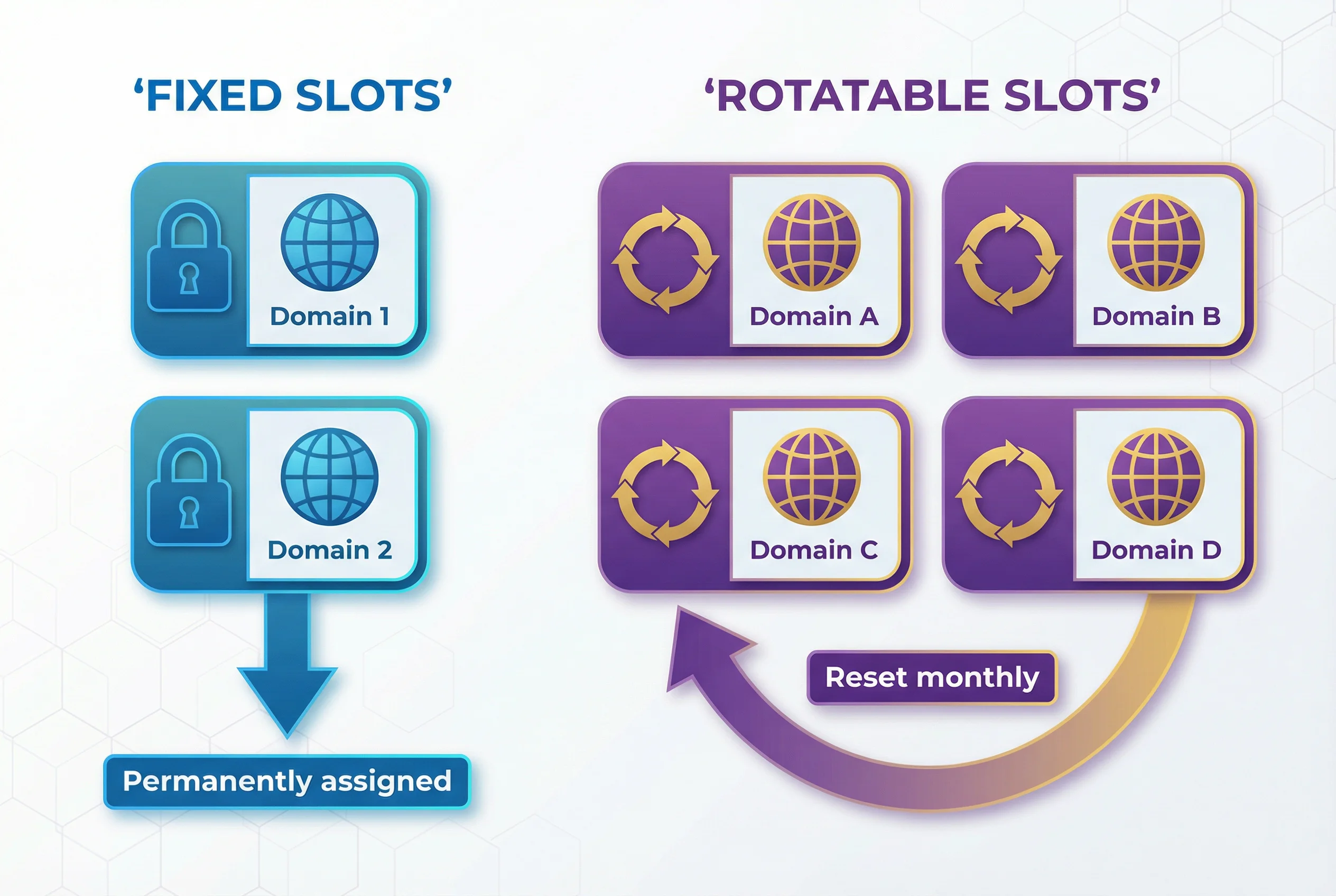
Domain management with fixed and flexible domain slots is a core part of any SEO tool. Ranketic offers two models for different needs.
Fixed Slots (Starter and Pro)
In the Starter and Pro plans, slots are fixed. Once a domain is scanned, it holds a slot for the full plan term. This binding stays until the user removes the domain or the plan ends.
This model suits firms and people with a few own sites. Starter offers 2 fixed domains, Pro offers 10.
Flexible Domains (Agency and Enterprise)
Agencies often manage many client domains that change. Agency and Enterprise offer flexible slots. At the start of each billing cycle, slots reset. New domains can be scanned without removing old ones.
The Agency plan has 200 flexible domains per month. Enterprise has 500. Within a month, each used domain acts like a fixed slot. The flexibility comes from the monthly reset.
Add-On Domains
Add-on domains can be booked with any plan. Each add-on brings one slot and 10 credits (2 full analyses). Prices scale by plan:
Larger plans get better rates on add-ons. This reflects volume savings. All plans and options are on the pricing page.
Plans in Detail
Ranketic offers five tiers — from a free start to the Enterprise package. Each plan covers a clear use case[6].
Free: The Start
Every new user gets 5 SEO analysis credits as a welcome gift. That covers one full analysis or five Quick Scans. No card needed, no strings. It lets users test the tool with their own site.
Starter: €29 / month
Starter is for freelancers and small firms with one or two sites. It covers regular SEO and GEO checks.
Example: A web designer runs their portfolio and one client site. With 25 credits, they scan each site twice in full (20 credits). The other 5 go to Quick Scans after changes.
Pro: €79 / month
Pro is for growing firms and marketing teams. It gives deeper data on traffic and rivals.
Example: A firm runs 6 sites (main site, blog, 4 country pages). With 100 credits, the team scans each site three times (90 credits). The other 10 go to Quick Scans after updates.
Agency: €249 / month
Agency is built for SEO agencies and marketing firms. Flexible slots let them onboard new clients each month.
Example: An SEO agency manages 50 clients with 2–3 domains each. With 200 slots and 2,000 credits, they scan each domain once per month. Quick Scans track progress. The REST API feeds data into existing tools.
Enterprise: €599 / month
Enterprise is for large firms and SEO platforms. It covers hundreds to thousands of domains. The SLA locks in response times. The API allows linking to existing systems.
Plan Comparison at a Glance
Add-Ons and Deep Dive
Add-On Domains in Detail
Add-on domains extend any plan. Each add-on is booked as a monthly plan. It adds one slot and 10 credits (2 full analyses or 10 Quick Scans).
Booking is done in the dashboard. Add-ons can be cancelled at any time. Credits for the current month stay.
The Deep Dive Package
Users who want no ongoing plan can buy the Deep Dive package once:
Deep Dive suits consultants. They can scan a client domain in depth and track progress — with no monthly tie. All options are on the pricing page.
The Ledger: Full Clarity
Clarity is a core value of the credit system. Schematic notes: "Credit-based systems give SaaS teams more flexibility in how they monetize, while helping customers stay in control of their budgets." [5] Ranketic follows this rule closely.
How the Ledger Works
Every credit move is stored as a fixed entry. A database trigger updates the balance after each booking. This gives three benefits:
Safety: The balance comes from the sum of all entries. It is never set by hand.
Clarity: Every balance change is fully logged.
Stability: Even with many entries at once, the balance stays right.
Who Sees What?
Access is based on role:
Use Cases
Case 1: Freelancer with Starter
Anna is a writer who runs her blog and one client site. She picks Starter (€29/month, 25 credits, 2 domains).
Start: 25 credits added
Week 1: Full analysis of blog (−5) and client site (−5). Balance: 15
Week 2: Tips applied. Quick Scan blog (−1) and client site (−1). Balance: 13
Week 3: New full analysis of blog after content update (−5). Balance: 8
Week 4: 3 Quick Scans to check progress (−3). Balance: 5
Anna ran 3 full analyses and 5 Quick Scans in one month. A rigid "5 analyses" quota would not have allowed any Quick Scans.
Case 2: Marketing Team with Pro
An online shop manages 8 domains (main shop, blog, 6 country shops). The team uses Pro (€79/month, 100 credits, 10 domains).
Start: 100 credits
Week 1: Full analysis of all 8 domains (−40). Balance: 60
Weeks 2–3: 20 Quick Scans after changes (−20). Balance: 40
Week 4: Full re-scan of the 3 top domains (−15). Balance: 25
The team switches between deep scans and quick checks — based on need.
Case 3: SEO Agency with Agency
An SEO agency manages 80 clients with 120 domains. They use Agency (€249/month, 2,000 credits, 200 flexible domains).
Start: 2,000 credits, 200 slots free
Week 1: Full analysis of all 120 domains (−600). Balance: 1,400
Week 2: 200 Quick Scans for reports (−200). Balance: 1,200
Week 3: 50 full re-scans (−250). Balance: 950
Week 4: 100 Quick Scans + 20 full scans for new clients (−200). Balance: 750
The agency uses the REST API for auto-scans. Flexible slots let them add new clients next month. Read more about the Ranketic story in our founding article.
Compared with Other SEO Tools
How does the Ranketic model stack up? A look at the market helps. Data comes from public pricing pages (as of March 2026).
Two things stand out: First, Ranketic is the only vendor with a built-in GEO analysis. It rates visibility in AI search systems like Google AI Overviews or ChatGPT Search. Second, the two-tier credit model (Quick Scan vs. full analysis) allows more flexible budget use.
The big tools offer wider features in keyword research, backlink data, and rank tracking. Ranketic is a focused SEO tool for combined SEO and GEO analysis. SEO-Tool-Preise (SEO tool prices) are well below the big vendors. This space is growing as AI search systems like Perplexity reach more users.
FAQ
Do unused credits expire? No. Credits from the plan stay as long as the plan is active. Only promo credits may have an end date.
Can I share credits in my team? Credits belong to the company account, not to single users. Every member uses the shared pool. The holder sees in the ledger who used which credits.
What happens when my credits run out? New scans start only when credits are back. This happens through the next monthly grant, an add-on, or an upgrade. Running scans are not stopped.
How do I switch plans? Upgrades take effect at once. The price gap is prorated. Downgrades kick in at the next billing cycle.
Are Quick Scan and full analysis scores the same? Yes. Both use the same rules and weights (35% Technical, 35% Content, 30% GEO). The only gap: the full analysis adds subpage scores, which can shift the total score slightly.
Sources
[1] Chargebee (2025). "Usage-based Pricing For Growth In A Changing Landscape." https://www.chargebee.com/blog/usage-based-pricing-for-growth-in-a-changing-landscape/
[2] Stripe (2025). "Credits pricing models for scaling businesses explained." https://stripe.com/resources/more/credits-pricing-models-for-scaling-businesses-explained
[3] DealHub (2026). "What is Credit-Based Pricing?" https://dealhub.io/glossary/credit-based-pricing/
[4] Flexera (2026). "From seats to consumption: why SaaS pricing has entered its hybrid era." https://www.flexera.com/blog/saas-management/from-seats-to-consumption-why-saas-pricing-has-entered-its-hybrid-era/
[5] Schematic (2025). "Is a Credit-Based System the Right Fit for Your SaaS Pricing?" https://schematichq.com/blog/is-a-credit-based-system-the-right-fit-for-your-saas-pricing
[6] SubscriptionFlow (2025). "Understanding the Credit Based Subscription Model." https://www.subscriptionflow.com/2025/07/credit-based-subscription-model/
[7] Ahrefs (2026). "Plans & Pricing." https://ahrefs.com/pricing
[8] Semrush (2026). "Plans & Pricing." https://www.semrush.com/pricing